
FREC 3 RPL vs Full FREC 3 Course – Which Route Is Right for You?
If you’re looking at FREC 3, one of the first questions is:
“Can I do the RPL route instead of the full course?”
Short answer — sometimes.
But this is where a lot of people get it wrong.
FREC 3 RPL (Recognition of Prior Learning) isn’t a shortcut. It’s a different route designed for people who already meet very specific criteria.
This guide breaks it down properly so you can make the right call.
What is FREC 3?
FREC 3 (First Response Emergency Care Level 3) is a regulated qualification designed for people who may be first on scene.
It sits between first aid and frontline ambulance work.
It covers things like:
Primary and secondary survey
Airway and breathing
Trauma and medical emergencies
Patient assessment and decision making
It’s not just about skills — it’s about thinking clearly under pressure.
What is FREC 3 RPL?
FREC 3 RPL stands for Recognition of Prior Learning.
It’s a shorter route (2 days) that allows you to gain the qualification without completing the full 5-day course.
But — and this is important — it’s only available if you can evidence that you’ve already covered the required learning.
The criteria are set by Qualsafe Awards and must be followed properly.
All learners must still complete the full FREC 3 assessments.
The Key Difference
Full FREC 3 Course
5 days
Built from the ground up
Teaches and assesses everything
FREC 3 RPL
Around 2 days
Assumes prior knowledge
Focuses on assessment rather than teaching
Who is RPL actually for?
RPL is designed for people who already hold recognised Level 3 pre-hospital care qualifications or equivalent.
Examples include:
FPOS (Level 3)
RTACC (Level 3)
Level 3 First Responder qualifications
Ambulance CFR roles
Fire and rescue casualty care training
Military medic training
👉 These must usually be:
Completed within the last 24 months
Supported with evidence
Still relevant to your current role
Just holding a certificate isn’t enough — you need to show that you’ve actually covered the required content.
Who is it NOT for?
This is where most confusion happens.
RPL is not suitable if you:
Have done basic first aid only
Have some experience but no formal qualification
Completed training a long time ago and haven’t used it
Can’t evidence your prior learning
Even if you feel confident, that doesn’t always meet the criteria.
Common mistake: “I’ve done similar before”
We hear this all the time.
People assume that because they’ve:
done bits of training
worked in related environments
or seen similar situations
…they can skip the full course.
In reality, RPL requires structured, evidenced learning, not just exposure.
Why the rules are strict
FREC 3 RPL isn’t flexible.
The criteria are set by Qualsafe Awards and must be applied consistently.
That’s because:
It’s a regulated qualification
It feeds into higher-level training like FREC 4
It needs to be safe and standardised
Centres must submit evidence for approval following courses.
Should you just do the full FREC 3 course?
In many cases — yes.
And that’s not a negative.
The full course gives you:
A proper structure
A deeper understanding
Confidence under pressure
We often see people who try to go down the RPL route but benefit more from doing the full course.
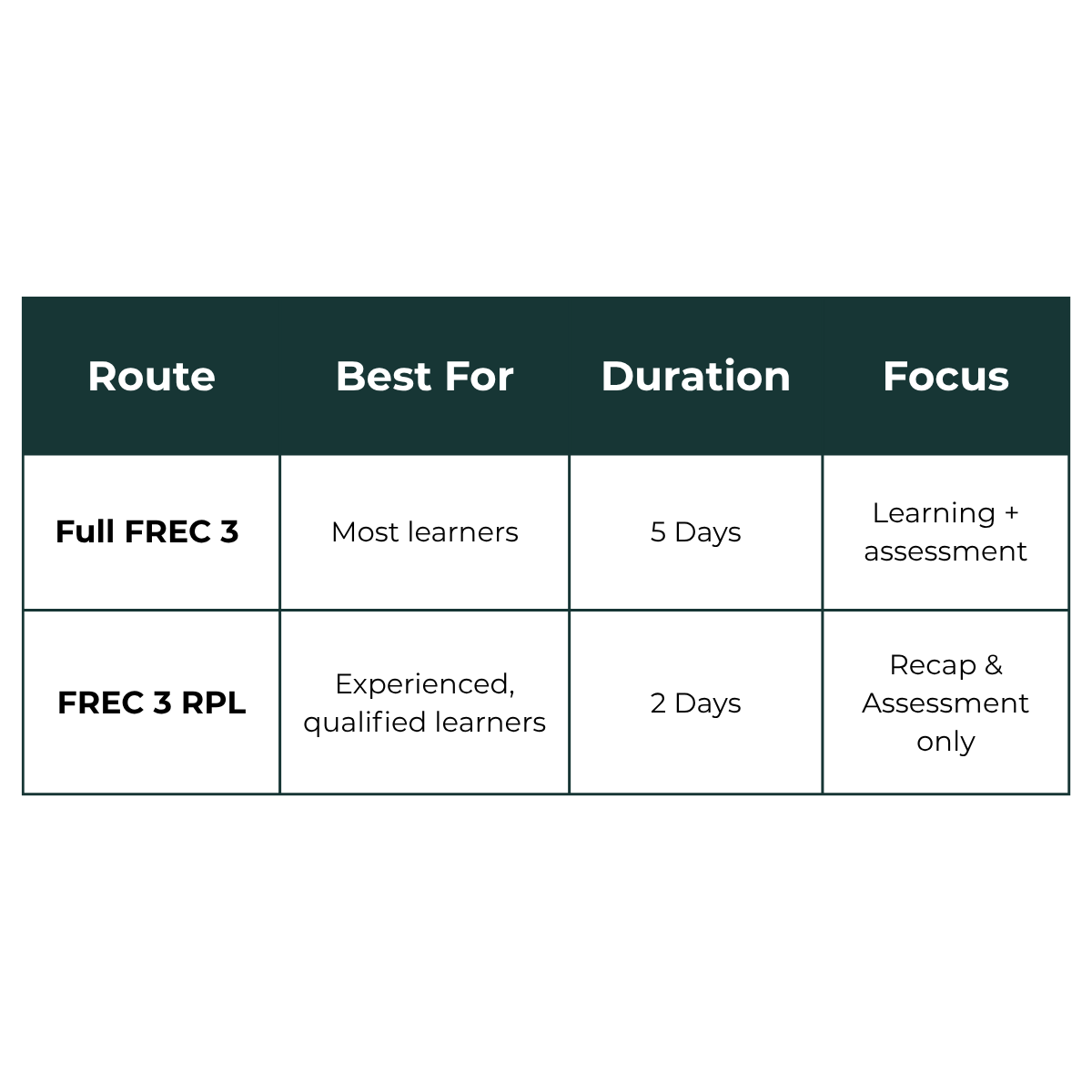
Quick comparison
So which one should you choose?
Choose RPL if:
You hold a recognised Level 3 qualification
It’s recent (within 24 months) OR you’re operational (for example a CFR)
You can evidence it properly
You’re confident working in a structured way
Choose full FREC 3 if:
You’re unsure
You don’t meet the criteria
You want to build confidence
Not sure? Here’s the easiest way
If you’re still unsure, don’t guess.
👉 Check your FREC 3 RPL eligibility in under 60 seconds:
Or send us your details and we’ll give you a straight answer.
Progression
Once you’ve completed FREC 3, you can move on to:
Final thought
RPL isn’t better than the full course.
It’s just different.
The goal isn’t to get through it as quickly as possible — it’s to be:
Safe
Structured
Confident under pressure
If you focus on that, you’ll be on the right path.
❓ Frequently Asked Questions
-
Only if you meet strict criteria. Most learners need FREC 3 or equivalent before progressing.
-
Use our FREC 3 RPL eligibility checker or send us your qualifications and experience.
-
Yes. In most cases, they must have been completed within the last 24 months
-
No. It’s shorter, but it assumes prior knowledge and is still fully assessed.
-
Recognised Level 3 pre-hospital care qualifications such as FPOS, RTACC, and approved emergency responder training are commonly accepted, subject to review
-
You’ll need to complete the full 5-day FREC 3 course, which gives you the foundation needed to progress safely
